
Forest is an asset that combines long-term stability of value, ongoing earnings opportunities and public benefit. For private owners - especially family businesses, family offices and organisations not financed by taxes - a clear, workable strategy is central if forest investments are to prove themselves as a reliable investment option under climate change.
Climate change is altering growing conditions, markets and production periods. This creates new tasks and calls for sound decisions. For property that is not financed by taxes, the point is to align the structure of the forest so that assets, earning power and room for manoeuvre are preserved in the long term.
1. Putting change into sober perspective
Since the 1960s the CO₂ concentration in the atmosphere has been rising steadily. This results in longer growing seasons, regionally pronounced dry spells, more intense heat periods and their knock-on effects. Many forests today consist of comparatively old, dense and sluggish structures. Under the changed conditions they can be steered more swiftly and more purposefully in order to secure growth and stability.
The long-term development of CO₂ concentration shows this trend clearly (see Figure 1): despite numerous international efforts (climate conferences), no reversal of the trend is discernible so far.
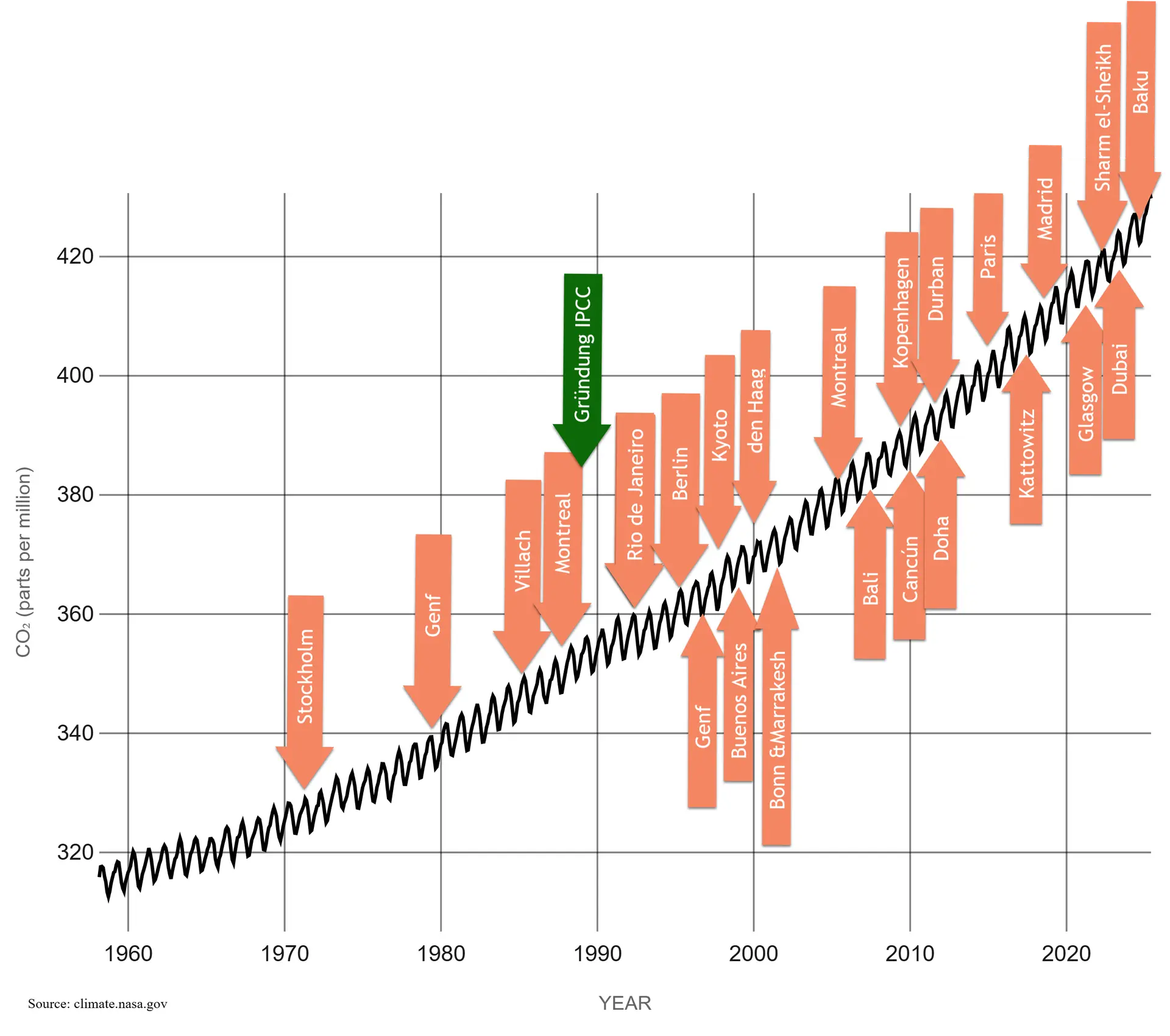
Figure 1: Development of CO₂ concentration since 1958 (Mauna Loa, NOAA/NASA), with selected climate conferences marked (e.g. Rio 1992, Kyoto 1997, Paris 2015, Glasgow 2021). Despite these conferences the rise continues largely unbroken.
These framework conditions cannot be changed, but they can be taken into account - and actively included in the asset management of forests.
2. Three guiding principles for future-proof forest assets
Three robust guiding principles can be derived from the practice of successfully managed private forests:
- Managing tied-up physical assets in the forest in a focused way
- Aligning investments with reliable, market-oriented options
- Strengthening biological, economic and organisational agility
These principles are classic tenets of asset management. Applied to the forest, they gain weight under climate change and call for practical experience - and for a willingness to question traditional patterns.
3. Managing tied-up capital deliberately
Forest assets consist essentially of land value and stand value. The land is tied up in the long term. The stand value can be actively shaped.
Private forests in Germany average around 393 m³/ha, in Switzerland around 402 m³/ha. Depending on assortment, region and revenue level, this growing stock corresponds to a tied-up value of roughly €25,000 to €50,000 per hectare (at average revenues net of harvesting costs). The decisive question is how high this stock should be. The aim is a stand structure that is stable, allows ongoing returns at a solid level and keeps damage and market risks within a bearable range.
Goal-oriented management steers growing stock so that
• high current increment,
• the assortments targeted (those with high added value) in the shortest possible periods
• and revenues in the case of unplanned harvesting
are ensured with the lowest possible capital input.
Consistent selective thinning typically reduces tied-up capital by around 30-50 % without diminishing annual earning power. This makes stands less risky, more productive and easier to steer flexibly. The capital released can flow into alternative investment options.
An indicative example (simplified order of magnitude):
• Conventional management: approx. 380 m³/ha → around €41,800/ha of tied-up capital
• Selective thinning: approx. 260 m³/ha → around €28,600/ha of tied-up capital
At the same revenue, tied-up capital falls by a good 30 %, while the ongoing harvesting options are retained.
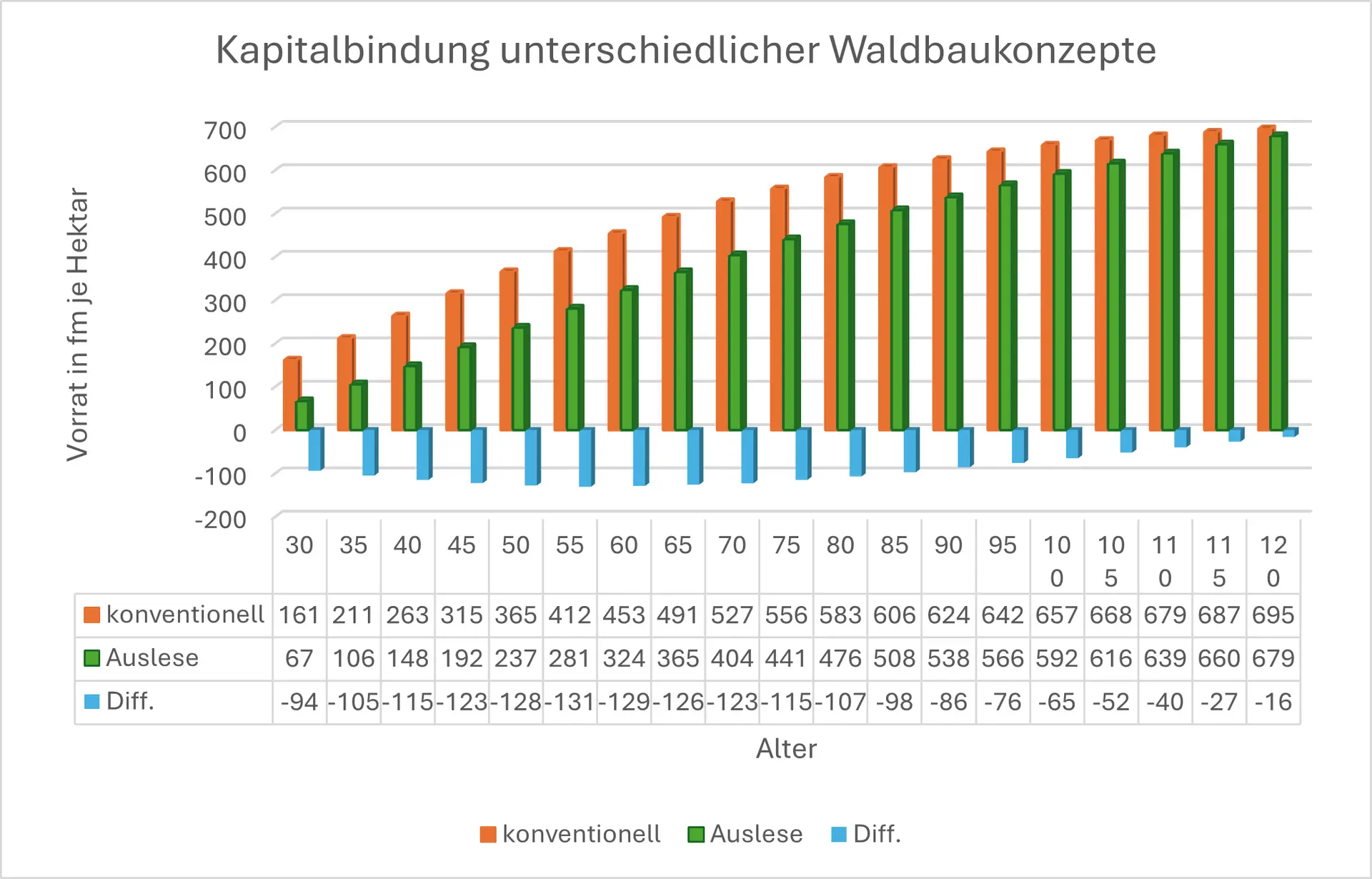
Figure 2: Illustrative comparison of growing stock and tied-up capital between conventional management (380 m³/ha) and selective thinning (260 m³/ha) at the same revenue assumption. Tied-up capital falls markedly - with comparable annual earning power. Shorter rotation periods favour efficient use of capital.
4. Making investments with a clear orientation
Not every tree species and not every management concept pays off equally well against the expected (uncertain) developments. A few clear principles provide orientation:
- Conifer species remain the economic foundation in Central Europe. They have stable sales markets and well-established value chains.
- Broadleaves support the structure of the forest where they can be produced economically at low production costs and marketed well as timber assortments. Short production periods are particularly important.
- Tree species with high production costs should be assessed soberly: site suitability, climate risks, tending effort and long-term market prospects. "Fashionable species" without a solid sales base tie up capital and increase risk.
A particularly effective lever lies in managing young forests. Reducing stem numbers in good time (with exceptions for species such as beech, which require their own treatment rules) promotes vigorous individual trees, good crown development (vitality) and shorter production periods. This increases flexibility and stability at the same time - biologically and economically.
5. Strengthening agility at several levels
Agility means planning in such a way that different developments can be handled without slipping into crisis mode.
Biological agility
Target-tree concepts help stands to reach economically viable dimensions even when harvesting occurs unpredictably. Anyone not bound by rigid (long) rotation periods can respond better to unplanned events (storm, bark beetle) or to market windows.
Economic agility
Values that are not tied up in the stand can be invested more flexibly and returned to the forest when needed. This increases responsiveness when opportunities arise or particular interventions become necessary.
Organisational agility
Structures should be designed so that they can be adapted to changing needs without high adjustment costs. A number of owners use flexible management models that
• ensure support that matches actual needs,
• reduce the single-person risk (concentration risk)
• and enable an ongoing transfer of knowledge and technology.
6. Implementation: working together with clear roles
For family businesses, family offices and organisations not financed by taxes, the strategic steering of their assets is a continuous process. A clear division of roles between owner, asset management and operational implementation supports this process.
· Important elements are:
• sound, traceable (verifiable) foundations for decisions (silvicultural and operational concepts),
• targeted management of growing stock, risks, costs and revenue potential,
• regular review of assumptions and targets against defined control variables (KPIs),
• continuous adaptation to site, market and stand development.
This ensures that forestry decisions and asset decisions remain consistent.